
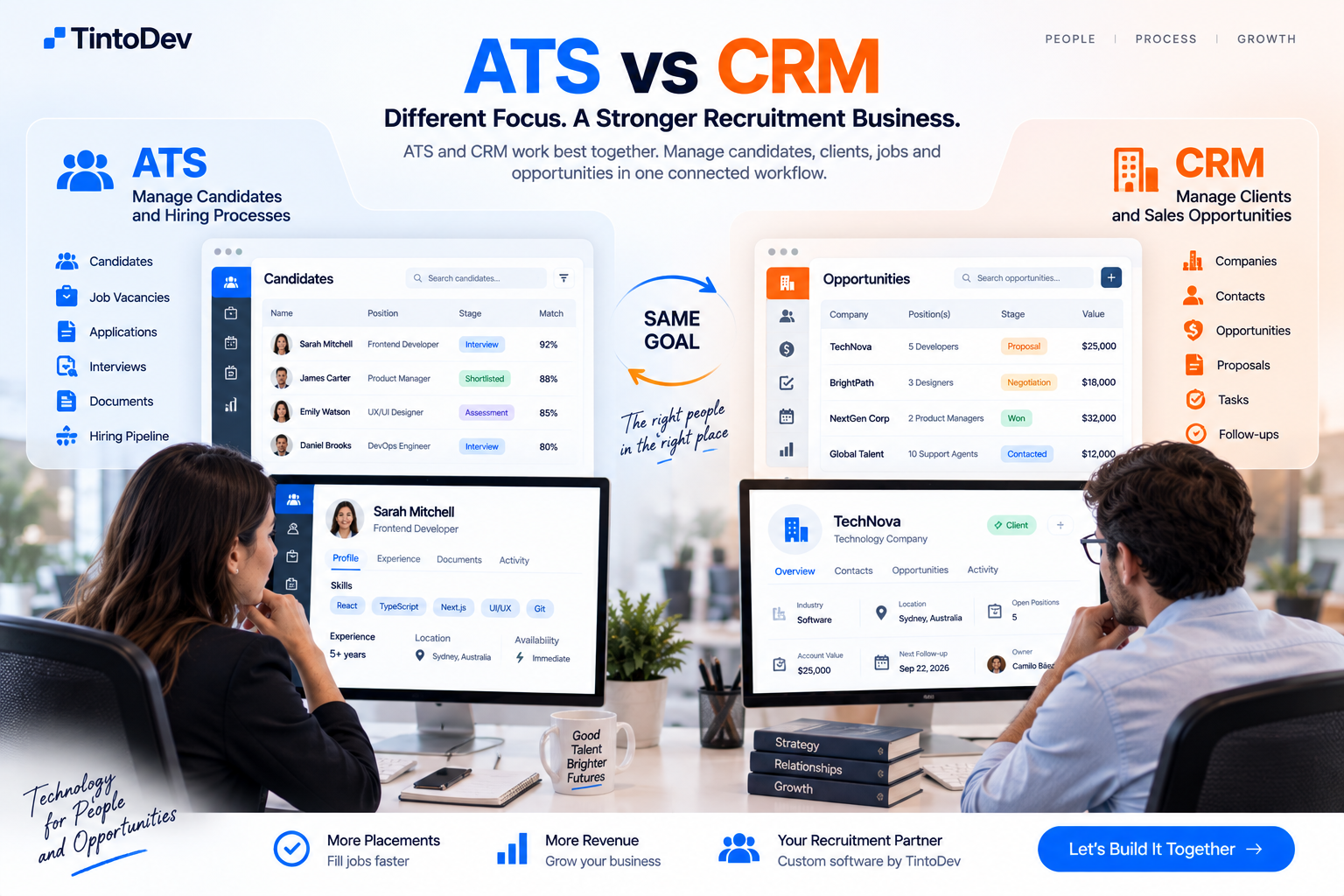
ATS vs CRM: Key Differences for Recruitment Companies
ATS and CRM systems serve different purposes in recruitment. Understanding how they work together helps companies manage candidates, clients, jobs, and sales opportunities more efficiently.
Recruitment companies primarily manage two types of relationships:
- candidates;
- clients.
Candidates move through recruitment and hiring processes.
Clients are the companies that need help finding and hiring talent.
Because of this, many recruitment agencies use two different types of software: an ATS and a CRM.
Although both systems can share information and work together, they serve different purposes.
Understanding the difference between an ATS and a CRM can help recruitment companies build a more organized operation and reduce their dependence on spreadsheets, emails, and disconnected tools.
What Is an ATS?
ATS stands for Applicant Tracking System.
It is a system designed to manage candidates and recruitment processes.
An ATS can manage:
- candidates;
- job vacancies;
- applications;
- interviews;
- documents;
- recruitment stages;
- assessments;
- communications;
- hiring.
Its main purpose is to help the recruitment team manage the process from the moment a candidate applies until that person is hired or rejected.
What Is a CRM?
CRM stands for Customer Relationship Management.
In a recruitment company, a CRM is mainly used to manage employer clients and sales opportunities.
A CRM can include:
- companies;
- contacts;
- sales opportunities;
- proposals;
- calls;
- meetings;
- tasks;
- follow-ups;
- commercial history.
The CRM helps the sales team organize relationships with companies that purchase recruitment services.
The Main Difference Between ATS and CRM
The main difference is simple:
ATS = candidates and recruitment processes.
CRM = clients and sales opportunities.
The ATS focuses on talent.
The CRM focuses on customers.
For a recruitment company, both can be important.
What Information Does an ATS Manage?
An ATS can store information such as:
- candidate name;
- resume;
- work experience;
- skills;
- education;
- languages;
- availability;
- salary expectations;
- documents;
- applications;
- interviews;
- recruitment status.
All this information relates to candidate management and hiring.
What Information Does a CRM Manage?
A recruitment CRM can store:
- company name;
- contact person;
- email;
- phone number;
- industry;
- opportunities;
- proposals;
- contracts;
- notes;
- meetings;
- requested vacancies.
This information is primarily related to the client relationship.
A Practical Example
Imagine a company called TechNova needs to hire five software developers.
Inside the CRM, the recruitment agency can register:
- TechNova;
- the main contact;
- the sales opportunity;
- proposal information;
- commercial terms;
- follow-up dates.
Once TechNova approves the recruitment process, the vacancies can be created.
Inside the ATS, the recruitment team manages:
- candidates;
- applications;
- interviews;
- assessments;
- finalists;
- hires.
The CRM manages the commercial relationship.
The ATS manages the recruitment delivery.
Why Recruitment Agencies May Need Both
A recruitment agency can operate with only an ATS or only a CRM for some time.
However, limitations usually appear as the company grows.
If the company only uses an ATS, candidate management may be excellent while sales activity remains poorly organized.
If the company only uses a CRM, client relationships may be well managed while recruitment workflows remain fragmented.
Connecting both systems creates a more complete operation.
Connecting ATS and CRM
When ATS and CRM modules are integrated, information can flow between them.
For example:
- the sales team creates an opportunity;
- the client approves the recruitment service;
- a vacancy is created;
- the vacancy moves into the ATS;
- recruiters search for candidates;
- candidates move through the hiring pipeline;
- candidate profiles are submitted to the client;
- a candidate is hired;
- the CRM records the successful placement.
This reduces duplicate work and manual data entry.
Creating Jobs From CRM Opportunities
For some recruitment companies, one commercial opportunity can create several vacancies.
For example, a client may request:
- three software developers;
- two designers;
- one project manager.
The CRM records the commercial opportunity.
The ATS can then create six active recruitment positions.
This keeps sales and recruitment operations connected.
Managing Client Information Inside the ATS
Although the ATS focuses primarily on candidates, recruiters may still need basic information about the client associated with each vacancy.
For example:
- company;
- contact;
- industry;
- location;
- active vacancies;
- responsible recruiter.
This gives recruiters useful context while working on each role.
The CRM Sales Pipeline
A recruitment CRM may use stages such as:
- lead;
- contacted;
- meeting;
- proposal;
- negotiation;
- won;
- lost.
The pipeline helps sales teams visualize commercial opportunities.
The ATS Candidate Pipeline
An ATS may use stages such as:
- applied;
- screening;
- interview;
- assessment;
- submitted to client;
- finalist;
- hired.
These pipelines are different, but they are directly connected to the same business operation.
ATS Automation
An ATS can automate processes such as:
- candidate emails;
- interview reminders;
- status changes;
- application forms;
- assessments;
- candidate classification;
- interviews;
- document requests.
This reduces repetitive work for recruiters.
CRM Automation
A CRM can automate:
- sales follow-ups;
- tasks;
- reminders;
- emails;
- notifications;
- pipeline changes;
- opportunity creation.
This helps sales teams maintain consistent client follow-up.
Automating Processes Across ATS and CRM
When both systems are connected, companies can create more advanced workflows.
For example:
When a sales opportunity is marked as won in the CRM:
- a vacancy can be created;
- a recruiter can be assigned;
- the recruitment team can receive a notification;
- the recruitment process can begin.
When a candidate is hired in the ATS:
- the commercial opportunity can be updated;
- the placement can be recorded;
- a billing process can be triggered.
This creates a workflow that connects sales directly with recruitment delivery.
ATS + CRM + Job Board
A complete recruitment platform can include three major components.
CRM
Manages employer clients and sales opportunities.
ATS
Manages candidates and recruitment processes.
Job Board
Publishes vacancies and receives candidate applications.
When these three components are connected, the recruitment process becomes much more efficient.
ATS + CRM + Artificial Intelligence
Artificial intelligence can add capabilities such as:
- candidate matching;
- resume analysis;
- candidate classification;
- profile summaries;
- candidate recommendations;
- sales opportunity prioritization.
AI can help reduce manual work in both recruitment and sales.
What Does a Small Recruitment Agency Need?
A small agency may start with basic functionality such as:
- candidate database;
- vacancies;
- recruitment pipeline;
- clients;
- contacts.
It does not necessarily need a complex platform from day one.
What Does a Growing Agency Need?
As the operation grows, the company may need:
- automation;
- complete CRM functionality;
- ATS;
- custom forms;
- reports;
- integrations;
- a job board;
- artificial intelligence.
What Does a Large Recruitment Company Need?
A recruitment company with several recruiters, teams, and clients may require:
- advanced permissions;
- multiple teams;
- dashboards;
- integrations;
- complex automation;
- advanced reporting;
- APIs;
- audit logs;
- artificial intelligence.
The platform should evolve with the operation.
Separate Software or a Unified Platform?
A recruitment company can use separate ATS and CRM systems.
This approach can work well when both platforms integrate correctly.
Another option is to use or develop a unified platform.
A single platform can reduce:
- duplicate information;
- unnecessary integrations;
- inconsistent data;
- manual work.
Benefits of a Unified ATS and CRM Platform
Some of the main benefits include:
- one centralized database;
- greater traceability;
- less duplicated data;
- better reporting;
- end-to-end automation;
- complete business visibility.
Management can understand what is happening from the initial client opportunity through to the final candidate placement.
When Should a Recruitment Company Use ATS and CRM Together?
Some common signs include:
- multiple active clients;
- many vacancies;
- several recruiters;
- an active sales pipeline;
- candidates participating in different processes;
- excessive spreadsheet usage;
- duplicated information;
- difficulty measuring results.
When these challenges become common, connecting ATS and CRM can significantly improve operations.
ATS and CRM Development With TintoDev
At TintoDev, we develop custom recruitment platforms that can combine ATS and CRM functionality in one solution.
A platform can include:
- candidates;
- companies;
- contacts;
- jobs;
- sales opportunities;
- recruitment pipelines;
- interviews;
- custom forms;
- documents;
- candidate matching;
- automation;
- artificial intelligence;
- reports;
- integrations.
The solution can be adapted to both the commercial and operational workflows of each recruitment company.
Conclusion
ATS and CRM systems do not perform the same function.
An ATS manages candidates and recruitment processes.
A CRM manages employer clients and sales opportunities.
For recruitment companies, the two systems complement each other.
When they are integrated, they can connect sales, vacancies, candidates, and successful placements within a single workflow.
This creates a more organized, measurable, and scalable recruitment operation.
Want to apply this in your business?
Let’s talk. We can guide you with no cost or commitment.