
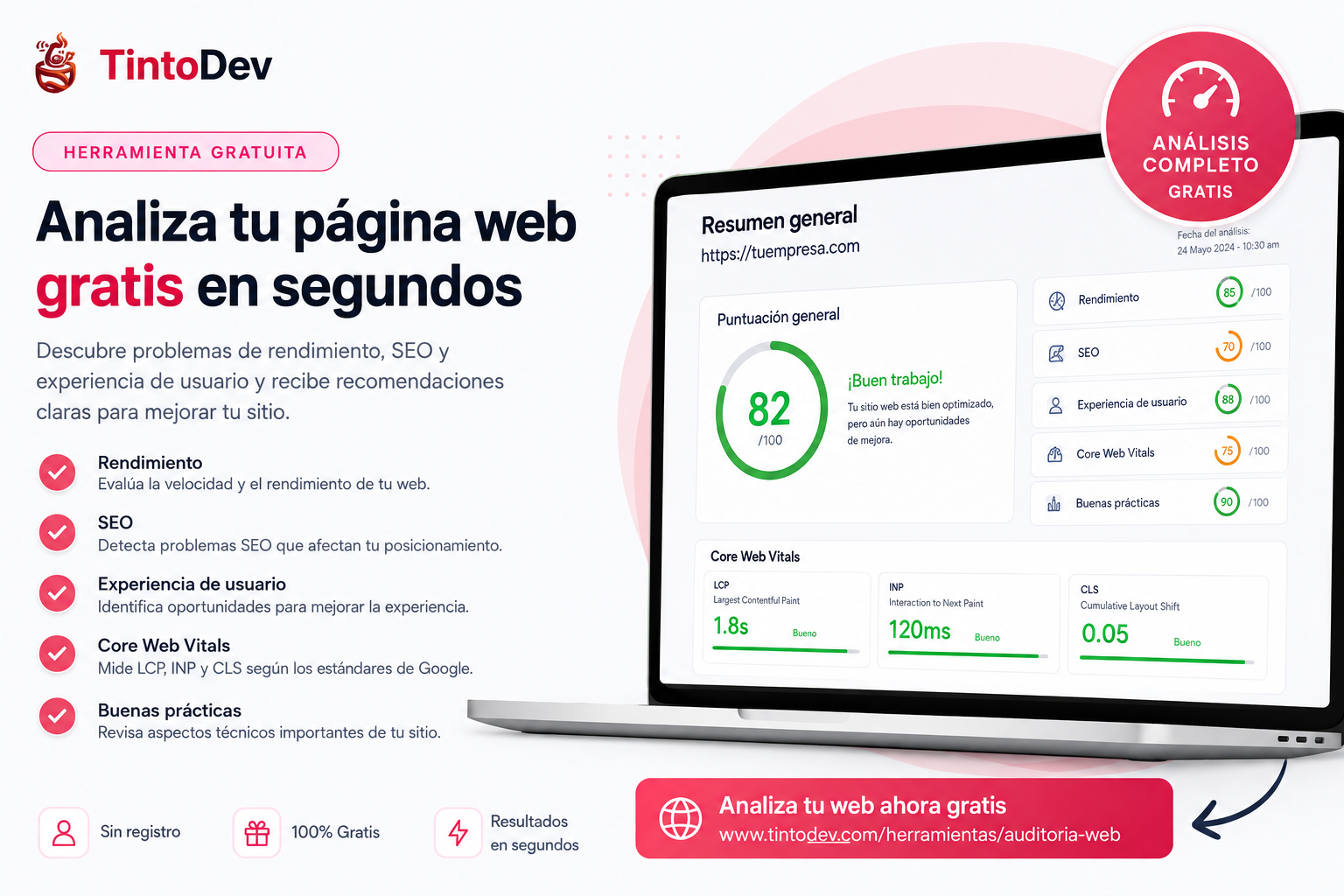
How to analyze a website SEO step by step
Analyse your website’s SEO, performance and Core Web Vitals for free with TintoDev Web Audit. Detect issues and discover what you can improve in seconds.
How to Analyse Your Website SEO for Free and Find What You Need to Improve
Having a website does not necessarily mean it is performing as well as it should.
Your website may look professional, offer great products or services, and even receive traffic, but it can still have issues related to SEO, speed, user experience, or technical performance that limit its results.
That is why running a website audit is one of the best ways to understand what is working, what is not, and what you should improve.
At TintoDev, we created a free tool that allows you to analyse your website in seconds and get clear information about its current performance.
What is a website audit?
A website audit is a technical analysis used to review different areas of a website and identify problems that may affect its performance, Google rankings, and user experience.
The goal is not only to find errors, but also to identify opportunities for improvement.
A website audit can help you detect issues such as:
- Slow loading times.
- SEO problems.
- Performance issues.
- Technical problems affecting user experience.
- Core Web Vitals issues.
- Elements that may be limiting your website’s visibility in search engines.
With this information, you can make better decisions about what to optimise first.
Why is it important to analyse your website SEO?
Google uses many factors to decide which websites appear higher in search results.
Content is still extremely important, but technical performance also plays a major role.
Some of the factors that can affect your website include:
- Website speed.
- Mobile responsiveness.
- Page structure.
- User experience.
- Overall performance.
- Visual stability.
- Loading times.
- Development best practices.
- SEO optimisation.
A website with technical issues may struggle to rank even when it offers excellent services, products, or content.
That is why regular website audits are recommended.
What are Core Web Vitals?
Core Web Vitals are metrics used by Google to measure the experience users have when visiting a website.
Some of the most important metrics include:
LCP – Largest Contentful Paint
LCP measures how long it takes for the main content of a page to become visible.
If the page takes too long to load, users may leave before they interact with the website.
INP – Interaction to Next Paint
INP measures how quickly a page responds when a user interacts with it, for example by clicking a button or using an interactive element.
CLS – Cumulative Layout Shift
CLS measures the visual stability of a webpage.
For example, if a button suddenly moves while a user is trying to click it, that can create a poor user experience and increase the CLS score.
How can you analyse a website for free?
To make this process easier, we developed TintoDev Web Audit, a free tool that allows you to analyse a website directly from your browser.
The process is simple.
You only need to enter your website URL and start the analysis.
The tool reviews important areas of your website and provides information that helps you understand where there may be opportunities for improvement.
You do not need to install any software or have advanced technical knowledge.
What does TintoDev Web Audit analyse?
Our tool is designed to review important aspects of website quality and performance, including:
Performance
It helps identify factors that may be affecting the speed and overall performance of your website.
SEO
It reviews important elements that can influence your visibility in search engines.
User experience
It helps identify issues that may negatively affect how visitors navigate and interact with your website.
Core Web Vitals
It reviews metrics related to speed, responsiveness, and visual stability.
Best practices
It can also help identify certain technical issues that may affect the overall quality of your website.
How often should you audit your website?
There is no single answer for every website.
However, it is a good idea to run an audit when:
- You launch a new website.
- You make important design changes.
- You install new plugins or features.
- Your website becomes slower.
- Your Google rankings drop.
- Your website traffic decreases.
- You want to start an SEO strategy.
- You are preparing a paid advertising campaign.
- You want to improve conversions.
Regular audits can also help you detect issues before they start affecting your results.
A faster website can also help you generate more leads
Website optimisation is not only a technical issue.
It can also have a direct impact on your business.
If a visitor lands on your website and it takes too long to load, they may leave.
If buttons respond slowly, navigation is confusing, or the page has visual problems, trust can decrease.
On the other hand, a fast and well-optimised website can make it easier for visitors to:
- Learn about your services.
- Explore your products.
- Submit a contact form.
- Contact you on WhatsApp.
- Request a quote.
- Make a purchase.
- Book a call.
That is why improving website performance can also support your overall sales and marketing strategy.
Try TintoDev Web Audit for free
If you want to understand the current condition of your website, you can run a free audit using our tool.
Simply enter your website URL.
No registration is required, and you can get results in seconds.
👉 Analyse your website for free with TintoDev Web Audit:
analyze your website for free with our audit tool
Identify opportunities to improve your website’s SEO, performance, and user experience, and discover what you can optimise to build a faster, more effective website that is ready to grow.
Want to apply this in your business?
Let’s talk. We can guide you with no cost or commitment.