
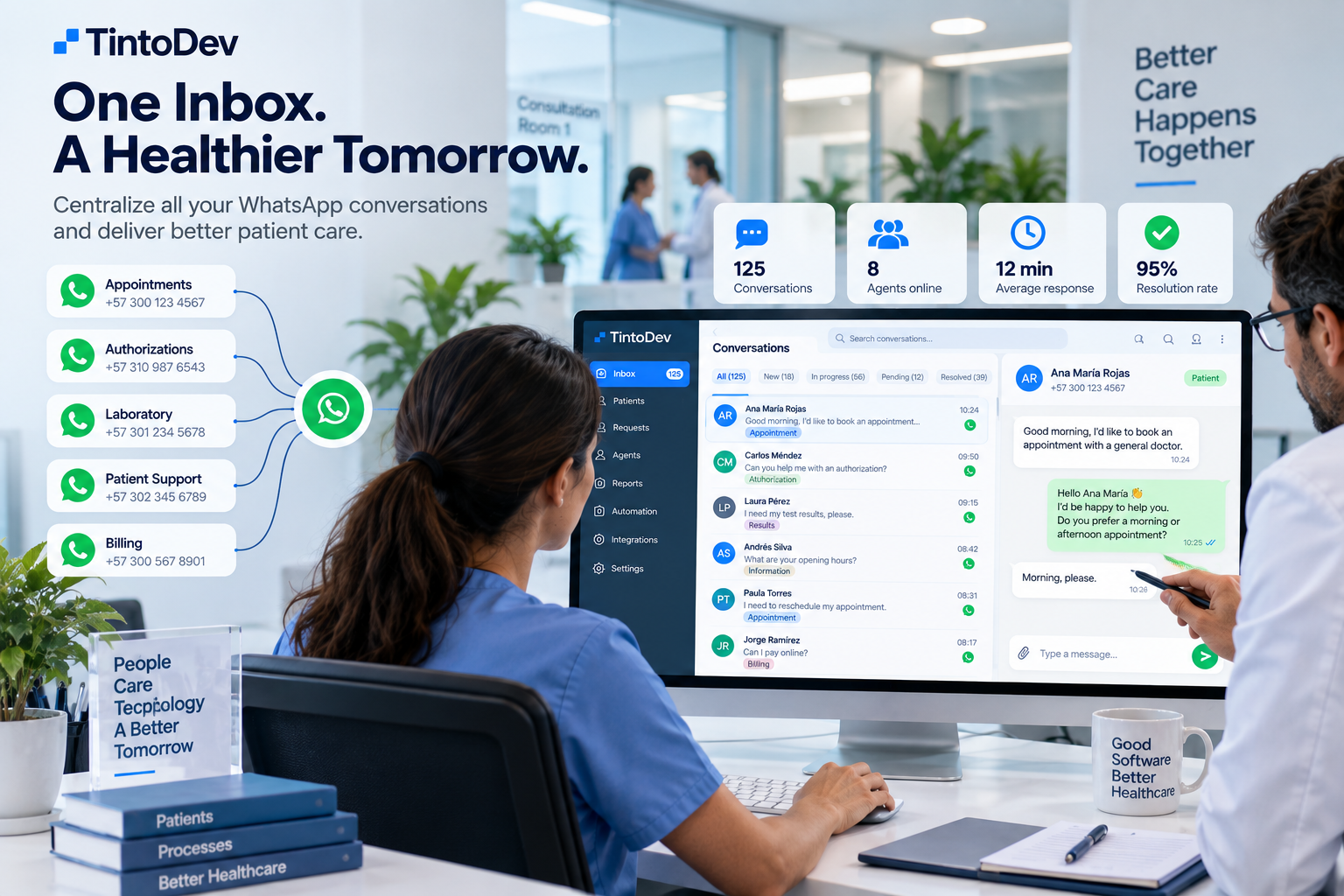
How to Centralize a Clinic’s WhatsApp Messages in One Platform
Centralizing WhatsApp helps clinics organize conversations, assign agents, avoid duplicate requests, and improve patient service management.
Many clinics, healthcare providers, and medical centers use WhatsApp as one of their main communication channels.
The problem begins when there are multiple phone numbers, several devices, and different team members replying to patients at the same time.
In this situation, patient communication can become difficult to manage.
Some messages may remain unanswered, others may be handled twice, and supervisors may not always know who is responsible for each request.
The solution is not necessarily to stop using WhatsApp.
A better approach is to centralize all WhatsApp conversations in a single platform.
This allows healthcare teams to continue communicating with patients through WhatsApp while managing the entire operation in a structured, traceable, and measurable way.
What Does It Mean to Centralize WhatsApp?
Centralizing WhatsApp means moving conversation management away from individual phones and into a business platform.
Instead of each agent checking a separate device, the entire team can work from one interface.
The platform can display:
- conversations;
- patients;
- requests;
- agents;
- statuses;
- priorities;
- response times;
- conversation history.
This transforms WhatsApp into a communication channel that is much easier to manage.
The Problem With Using Multiple Phones
In many healthcare organizations, WhatsApp usage grows gradually.
A clinic may start with one phone number.
Later, another number is created for appointments.
Another one is used for authorizations.
Another for laboratory services.
A different location may also have its own number.
Over time, the organization can end up managing multiple phones, accounts, and teams.
This can create problems such as:
- scattered conversations;
- missed messages;
- limited supervision;
- duplicated information;
- poor traceability;
- inconsistent response times.
Centralization helps reduce this fragmentation.
One Inbox for the Entire Team
A centralized platform can provide a shared inbox.
From there, the team can see all active conversations.
Each request may include:
- patient name;
- phone number;
- date;
- time;
- request type;
- status;
- assigned agent;
- priority.
This makes daily operations much easier to manage.
Assign Every Conversation to an Agent
One of the biggest benefits of centralizing WhatsApp is knowing exactly who is responsible for each request.
Every conversation can be assigned to a specific agent.
This helps prevent situations such as:
- two people replying to the same patient;
- nobody handling a request;
- conversations without an owner;
- difficulty identifying who completed a task.
Assignments can also be automated.
Automatically Distribute Conversations Among Agents
When message volume is high, manually assigning every conversation can become inefficient.
The platform can distribute requests according to rules such as:
- availability;
- department;
- branch;
- request type;
- working hours;
- workload;
- priority.
This helps balance work across the team.
Classify Conversations by Request Type
Not every conversation has the same purpose.
A clinic may receive messages related to:
- appointments;
- authorizations;
- test results;
- laboratory services;
- diagnostic imaging;
- billing;
- procedures;
- general information.
Classifying conversations makes them easier to organize.
It also helps route each request to the correct department.
Use Statuses to Control Each Case
Every request can have its own status.
For example:
- new;
- assigned;
- in progress;
- pending;
- waiting for patient;
- waiting for authorization;
- resolved;
- closed.
These statuses allow the team to quickly understand what is happening with each case.
Complete Conversation History
A centralized platform can also preserve the complete history of each request.
This may include:
- messages;
- status changes;
- assigned agents;
- reassignments;
- dates;
- response times.
Traceability becomes especially important when several people are involved in the same case.
Prevent Duplicate Requests
One common problem occurs when a patient sends several messages about the same issue.
If employees work from different phones, multiple agents may end up handling the same request.
A platform can help identify possible duplicates using:
- phone number;
- identification number;
- email;
- request type;
- date.
This helps reduce unnecessary work.
Reassign Requests Between Departments
A conversation may initially reach the wrong department.
The platform should make it easy to reassign the case.
For example:
A request reaches general customer service but should actually be handled by the authorizations team.
The agent can transfer it to the correct department.
The system records the change.
This preserves traceability throughout the process.
Centralize Multiple WhatsApp Lines
A healthcare organization may operate different WhatsApp lines.
For example:
- appointments;
- authorizations;
- patient service;
- laboratory;
- billing.
A centralized platform can allow the organization to manage different lines from a single interface.
Agents can still identify which channel each conversation came from.
Monitor Team Workload
Once communication is centralized, supervisors can see how many requests each agent is handling.
This makes it possible to identify:
- overloaded agents;
- available agents;
- departments with high demand;
- accumulated requests.
This information can help improve workload distribution.
Create Alerts for Long Waiting Times
The platform can generate alerts when a conversation remains unattended for too long.
For example, the system may:
- create an initial alert;
- notify a supervisor;
- increase priority;
- reassign the conversation.
This can help reduce patient waiting times.
Performance Indicators for Supervisors
A centralized platform also makes operations measurable.
Some useful indicators include:
Conversations Received
Total number of conversations during a specific period.
Requests by Service Line
Shows which communication channel or department receives the highest volume.
Requests per Agent
Helps measure workload distribution.
First Response Time
Measures how long patients wait before the team begins handling their request.
Resolution Time
Measures how long it takes to complete a request.
Duplicate Requests
Shows how much additional work is being generated by duplicate cases.
Reassignments
Helps identify routing or classification problems.
Connect Conversations With Patient Profiles
Conversations can be linked to individual patient profiles.
A profile may include:
- name;
- phone number;
- email;
- identification number;
- previous requests;
- appointments;
- history.
This gives agents more context when responding to patients.
Integration With Internal Systems
A centralized WhatsApp platform can also connect with other systems.
For example:
- CRM;
- scheduling platforms;
- ERP;
- billing systems;
- healthcare software;
- databases;
- internal APIs.
This helps prevent information from being scattered across multiple tools.
Automated Responses
Once WhatsApp is centralized, repetitive tasks can also be automated.
For example:
- initial responses;
- frequently asked questions;
- classification;
- assignments;
- alerts;
- follow-ups.
Automation can reduce repetitive manual work for the team.
Artificial Intelligence for Conversation Management
Artificial intelligence can also help manage large volumes of conversations.
For example, AI can:
- identify intent;
- classify messages;
- summarize conversations;
- suggest responses;
- extract information;
- identify priority cases.
This can increase team efficiency.
Security and Permissions
Not every user should have access to the same information.
A centralized platform can use different user roles.
Administrator
Manages system settings and users.
Supervisor
Monitors agents, performance indicators, and reassignments.
Operator
Handles assigned conversations and requests.
This creates better control over access to information.
Benefits of Centralizing WhatsApp
Some of the main benefits include:
- one centralized inbox;
- better operational control;
- fewer duplicate requests;
- fewer missed messages;
- greater traceability;
- better workload distribution;
- measurable response times;
- performance indicators for supervisors;
- integration with other systems.
When Should a Clinic Centralize WhatsApp?
Some clear signs include:
- several phones;
- multiple WhatsApp lines;
- several agents;
- unanswered requests;
- patients sending repeated messages;
- unclear ownership of conversations;
- limited traceability;
- lack of performance indicators;
- excessive manual processes.
If several of these problems are present, centralizing WhatsApp can significantly improve operations.
Start With a Simple Platform
It is not necessary to build a large system from the beginning.
A first version can include:
- centralized inbox;
- users;
- requests;
- statuses;
- assignments;
- conversation history.
Later, additional features can be added, such as:
- automation;
- performance indicators;
- artificial intelligence;
- integrations;
- advanced business rules.
WhatsApp Centralization With TintoDev
At TintoDev, we develop custom business platforms designed to centralize customer and patient communication.
For clinics and healthcare providers, a solution can include:
- WhatsApp integration;
- centralized inbox;
- multiple agents;
- patient management;
- request management;
- statuses;
- assignments;
- reassignments;
- duplicate detection;
- performance indicators;
- auditing;
- automation;
- artificial intelligence;
- integrations.
The platform can be adapted to the specific workflows of each organization.
Conclusion
WhatsApp can be an excellent channel for patient communication, but using multiple phones and disconnected channels can make operations difficult to control.
Centralizing all conversations in one platform allows teams to organize their work more effectively.
It also helps assign responsibility, prevent duplicate requests, measure response times, and maintain complete traceability.
For clinics and healthcare providers experiencing growing message volumes, centralizing WhatsApp can be an important step toward improving patient service and scaling operations.
Want to apply this in your business?
Let’s talk. We can guide you with no cost or commitment.