
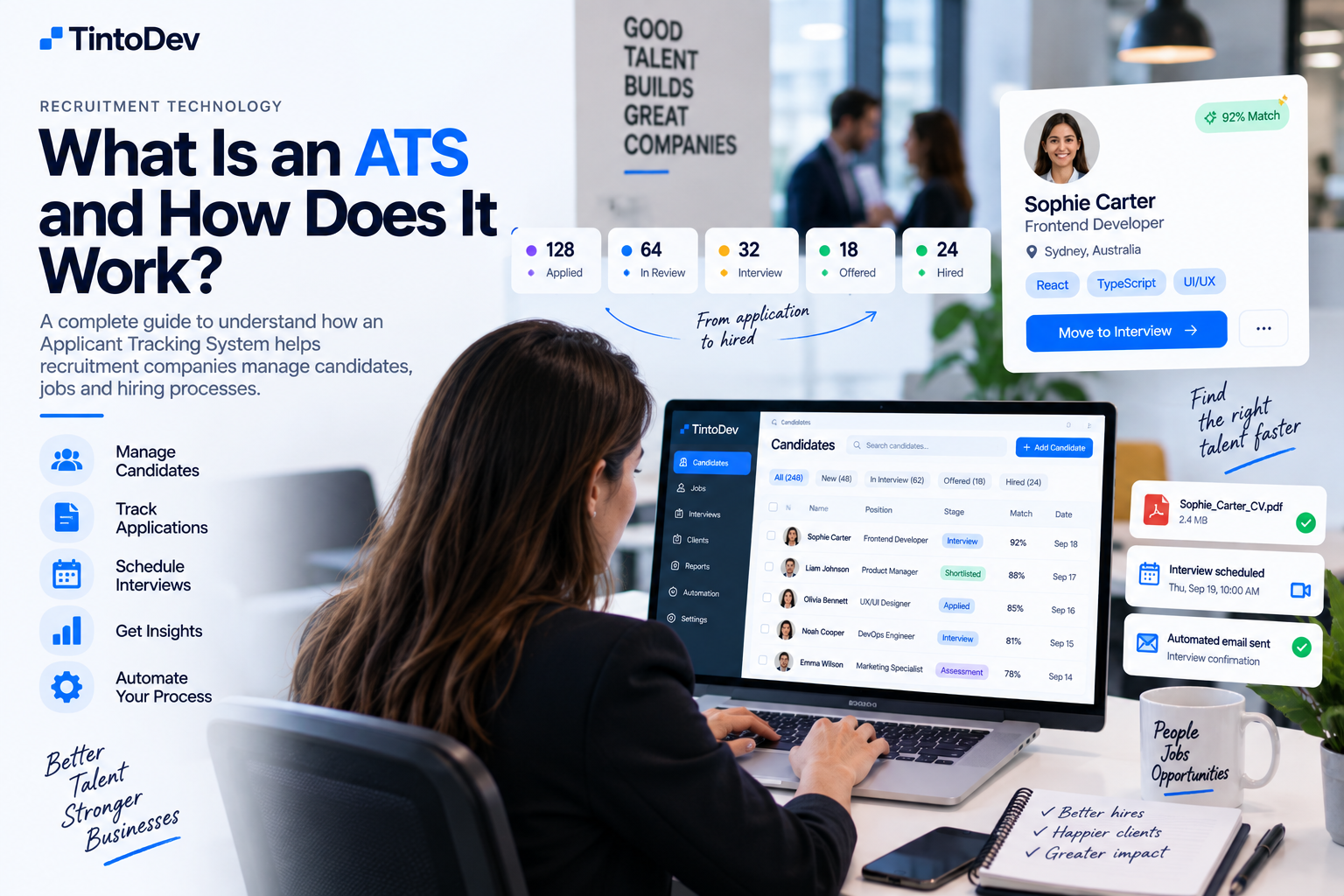
What Is an ATS and How Does It Work in a Recruitment Company?
An ATS helps recruitment companies manage candidates, jobs, interviews, applications, and hiring processes from one centralized platform.
Recruitment companies manage large volumes of candidates, job openings, interviews, documents, and communications every day.
When all this information is handled through spreadsheets, emails, folders, and separate tools, the process can become slow and difficult to control.
This is where an ATS, also known as an Applicant Tracking System, becomes useful.
An ATS is a system designed to organize and manage the entire recruitment process.
It allows companies to centralize candidates, jobs, applications, interviews, statuses, and communications in one platform.
What Does ATS Mean?
ATS stands for:
Applicant Tracking System
Its main purpose is to help recruitment agencies, staffing companies, and HR teams manage candidates throughout the hiring process.
What Problem Does an ATS Solve?
Without a centralized system, a recruitment company may end up using:
- Excel;
- Google Sheets;
- email;
- shared folders;
- online forms;
- WhatsApp;
- documents;
- calendars;
- job boards.
The problem is not using these tools individually.
The problem appears when information becomes scattered across all of them.
An ATS centralizes the recruitment process.
Candidate Management
One of the main functions of an ATS is creating a profile for each candidate.
The profile can include:
- name;
- email;
- phone number;
- location;
- work experience;
- skills;
- education;
- languages;
- availability;
- salary expectations;
- resume;
- documents.
This keeps all candidate information in one place.
Job Management
An ATS also allows recruitment teams to create and manage job openings.
Each job can include:
- job title;
- client;
- description;
- requirements;
- location;
- salary;
- work arrangement;
- experience;
- skills;
- responsible recruiter;
- status.
This makes it easier to control all active recruitment processes.
Candidate Applications
When a candidate applies for a job, the ATS can automatically record the application.
It can connect:
- candidate;
- job;
- application date;
- source;
- status;
- recruiter.
This allows the team to track progress without relying on spreadsheets.
Recruitment Pipeline
An ATS usually allows recruiters to visualize each hiring process through stages.
For example:
- applied;
- review;
- shortlisted;
- interview;
- assessment;
- submitted to client;
- finalist;
- hired;
- rejected.
This pipeline makes it easy to see where each candidate is in the process.
Interview Tracking
The ATS can also register interview information.
For example:
- date;
- time;
- interviewer;
- interview type;
- notes;
- outcome;
- next action.
It can also integrate with external calendars.
Document Management
During the recruitment process, candidates may submit different documents.
For example:
- resumes;
- certificates;
- references;
- identification;
- licenses;
- permits.
The ATS can store these documents directly inside the candidate profile.
Advanced Candidate Search
When a recruitment agency has thousands of candidates, finding the right profile can become difficult.
An ATS can offer filters by:
- experience;
- profession;
- location;
- skills;
- language;
- salary;
- availability;
- status;
- industry.
This can significantly reduce search time.
Candidate Matching
Some ATS platforms also include candidate matching.
Matching compares candidate information with job requirements.
The system may analyze:
- skills;
- experience;
- location;
- education;
- availability;
- salary expectations.
This helps recruiters identify candidates with stronger alignment.
ATS With Artificial Intelligence
Artificial intelligence can improve how an ATS works.
For example, AI can help:
- analyze resumes;
- extract information;
- classify candidates;
- summarize profiles;
- identify skills;
- compare candidates with jobs;
- suggest relevant candidates.
This can speed up the first stages of the recruitment process.
Communication Automation
An ATS can also automate candidate communication.
For example:
- application confirmation;
- interview invitation;
- reminders;
- document requests;
- status updates;
- rejection notifications.
This allows recruitment teams to maintain more consistent communication.
Forms Inside the ATS
An ATS can include custom forms.
These can be used for:
- candidate registration;
- applications;
- evaluations;
- document collection;
- pre-screening.
The information entered can automatically update the candidate profile.
Job Board Integration
An ATS can also connect with a careers portal or job board.
This allows agencies to publish vacancies and receive applications directly.
Depending on available APIs, it may also integrate with external job platforms.
CRM Integration
For recruitment agencies, an ATS can be complemented by a CRM.
The ATS manages candidates.
The CRM manages:
- clients;
- companies;
- contacts;
- opportunities;
- proposals;
- commercial follow-ups.
When both are connected, the recruitment company gains a complete view of candidates and clients.
Reports and KPIs
An ATS can also generate important performance indicators.
For example:
Time to Hire
Measures how long it takes to complete a recruitment process.
Candidates per Job
Shows how many candidates are participating in each vacancy.
Stage Conversion
Shows how many candidates move from one stage to another.
Candidate Source
Shows where candidates are coming from.
Active Jobs
Shows how many recruitment processes are currently open.
Recruiter Performance
Shows how many jobs and candidates each recruiter is managing.
Benefits of Using an ATS
Some of the main benefits include:
- centralized information;
- better organization;
- less manual work;
- greater traceability;
- faster candidate search;
- better follow-up;
- automation;
- better reporting;
- scalability.
ATS for Recruitment Agencies
Recruitment agencies have different needs compared with internal HR departments.
They usually need to manage:
- multiple clients;
- many job openings;
- large candidate databases;
- different recruiters;
- several active recruitment processes.
For this reason, an ATS designed for agencies often needs greater flexibility.
Generic ATS vs Custom ATS
There are many commercial ATS platforms available.
However, not all of them fit every recruitment workflow.
A company may need:
- custom stages;
- custom fields;
- specific forms;
- specialized matching;
- custom automation;
- CRM integration;
- a branded job portal;
- tailored reports.
In these cases, a custom ATS may be a better alternative.
When Does a Company Need an ATS?
Some common signs include:
- too many spreadsheets;
- duplicate candidates;
- difficulty finding profiles;
- poor traceability;
- repetitive manual work;
- applications spread across different tools;
- lack of reports;
- growth of the recruitment team.
When these problems become frequent, implementing an ATS can significantly improve operations.
Custom ATS Development With TintoDev
At TintoDev, we develop custom recruitment platforms.
An ATS solution can include:
- candidates;
- jobs;
- applications;
- recruitment pipeline;
- interviews;
- documents;
- forms;
- candidate matching;
- artificial intelligence;
- automation;
- CRM;
- reports;
- integrations.
The platform can be adapted to the specific processes of each recruitment company.
Conclusion
An ATS helps organize and control the entire recruitment process.
It centralizes candidates, jobs, applications, interviews, and documents.
It can also include automation, artificial intelligence, and candidate matching to improve productivity.
For recruitment companies managing large volumes of candidates and active hiring processes, an ATS can become an essential system for scaling operations.
Want to apply this in your business?
Let’s talk. We can guide you with no cost or commitment.