
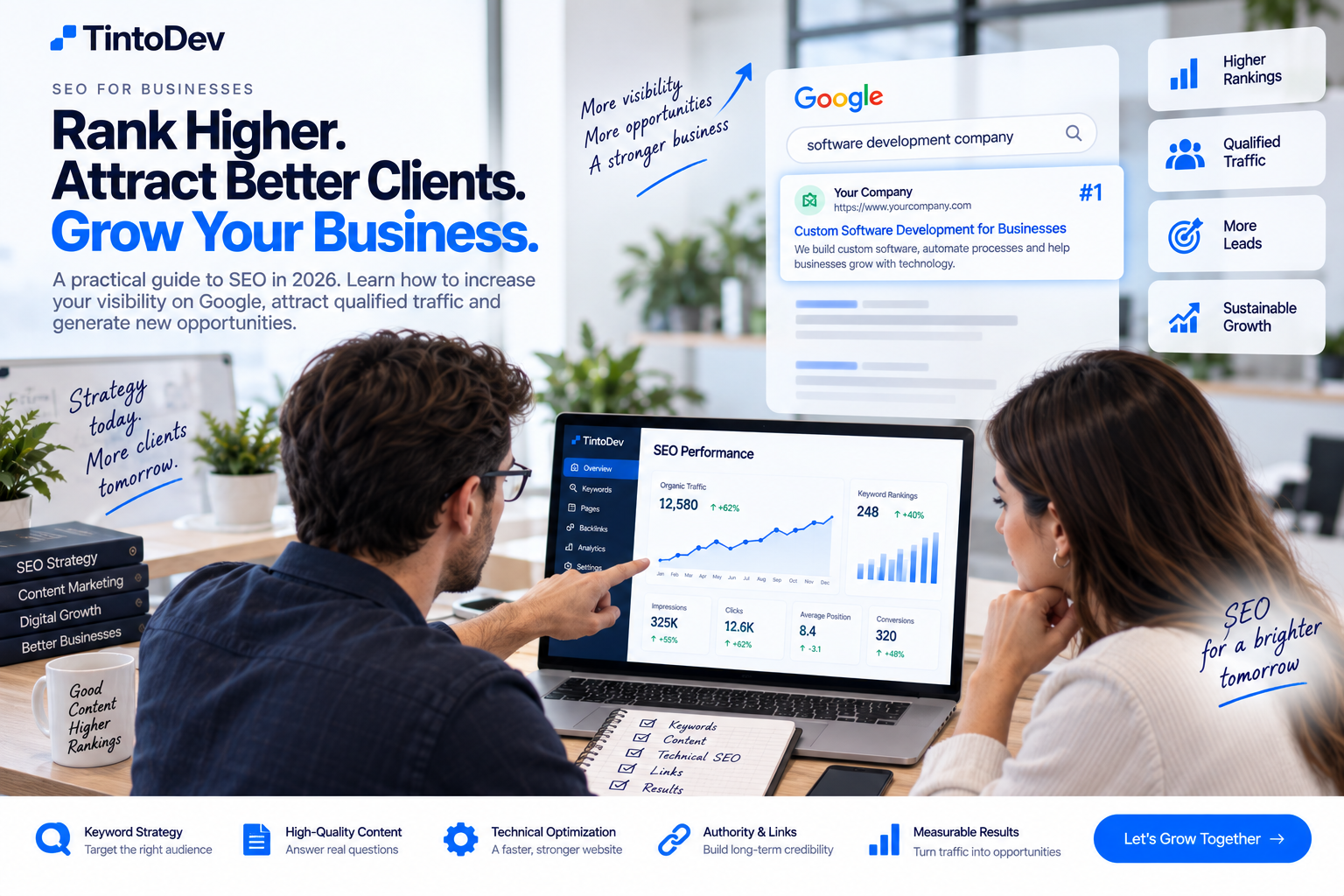
SEO for Businesses: How to Rank Your Company on Google in 2026
A strong SEO strategy can help businesses increase visibility on Google, attract qualified organic traffic, and generate new business opportunities consistently.
Having a website does not automatically mean potential customers will find it.
Many businesses invest in web design, development, and content only to discover that their website receives very little traffic from Google.
The problem is not necessarily the website itself.
The problem may be that the website has not been properly optimized for search engines.
SEO for businesses is the process of improving a website so that it can gain greater visibility in Google and attract people who are actively searching for relevant products, services, or solutions.
When implemented correctly, SEO can become a long-term customer acquisition channel.
Unlike paid advertising, organic visibility does not disappear immediately when a campaign budget is paused.
A page that ranks for relevant searches can continue generating traffic over a long period of time.
What Is SEO?
SEO stands for Search Engine Optimization.
Its goal is to improve a website's visibility when people search for topics related to a business.
For example, a software development company may want to appear for searches such as:
- custom software development;
- software development company;
- business process automation;
- custom CRM development;
- healthcare software;
- recruitment software.
A clinic may want to rank for searches related to its medical services.
A real estate company may want to appear when people search for properties in a particular location.
SEO connects the user's search intent with relevant content from a business.
Why Is SEO Important for Businesses?
Google is one of the first places people use when researching products, services, suppliers, and solutions.
Before making a decision, potential customers may search for:
- a company;
- a service provider;
- a solution to a problem;
- pricing information;
- alternatives;
- reviews;
- educational information.
If your company does not appear in those searches, another company may capture that opportunity.
SEO helps businesses compete for this visibility.
SEO Is Not Only About Ranking Number One
One common mistake is assuming that SEO is simply about achieving the first position in Google.
The more important goal is attracting relevant traffic.
Thousands of visitors have little value if none of them are interested in your services.
For a B2B company, 200 monthly visitors searching for a specific business solution may be more valuable than 10,000 visitors with no commercial intent.
This is why SEO strategy starts with keyword research and search intent.
What Are Keywords?
Keywords are the words and phrases people enter into search engines.
For example:
healthcare software
is a keyword.
A more specific search could be:
software to manage WhatsApp conversations for clinics
Longer and more specific searches are often called long-tail keywords.
They may receive fewer searches, but the user usually has a more specific need.
Understanding Search Intent
Not every keyword represents the same type of user.
Search intent can usually be divided into several categories.
Informational Intent
The user wants to learn something.
Example:
what is an ATS
Commercial Intent
The user is researching potential solutions.
Example:
best recruitment software for agencies
Transactional Intent
The user may be closer to purchasing or contacting a provider.
Example:
custom software development company
Navigational Intent
The user is searching for a specific brand or website.
Example:
TintoDev software
A strong SEO strategy can target multiple types of intent.
How to Choose Keywords for a Business
Businesses should not choose keywords only because they have high search volume.
Other factors matter, including:
- relevance;
- search intent;
- competition;
- search volume;
- relationship to the company's services;
- conversion potential.
For example, a software company could try to rank for:
technology
But this term is extremely broad.
A keyword such as:
recruitment software for agencies
is much more specific and directly connected to a potential commercial service.
Build Topic Clusters
A strong SEO strategy should not rely on isolated blog posts.
Content can be organized into topic clusters.
For example:
Healthcare Software Cluster
- software for clinics;
- WhatsApp for healthcare;
- healthcare automation;
- patient management;
- healthcare platforms.
Recruitment Cluster
- recruitment software;
- ATS;
- recruitment CRM;
- recruitment automation;
- candidate matching.
SEO Cluster
- SEO for businesses;
- technical SEO;
- On-Page SEO;
- keyword research;
- website rankings;
- Google Search Console.
This structure helps build topical depth around important services.
What Is a Pillar Page?
A pillar page is a comprehensive piece of content covering a broad topic.
For example:
SEO for Businesses: How to Rank Your Company on Google
More specific articles can then support the pillar page.
For example:
- technical SEO;
- local SEO;
- internal linking;
- keyword research;
- backlinks.
These articles can link back to the pillar page and to each other when relevant.
On-Page SEO
On-Page SEO includes optimizations made directly on a website.
It can include:
- page titles;
- headings;
- content;
- meta titles;
- meta descriptions;
- URLs;
- images;
- internal links;
- page structure.
Every important page should have a clearly defined purpose and topic.
SEO Titles
A title helps users and search engines understand what a page is about.
A good title should be:
- clear;
- specific;
- relevant;
- useful.
For example:
How to Automate WhatsApp for a Clinic
is much more specific than:
Digital Solutions for Modern Businesses
Specific titles generally communicate search intent more clearly.
Meta Descriptions
The meta description can appear below the title in search results.
It should summarize what the user will find on the page.
Instead of simply repeating keywords, write it to encourage qualified users to visit the page.
Heading Structure
Content should have a logical hierarchy.
Typically:
H1
The main page title.
H2
Major sections.
H3
Subsections.
This makes content easier for users to scan and helps clarify the structure of the page.
Create Helpful Content
Search engines aim to provide results that answer the user's query effectively.
Because of this, content should not be created simply to repeat keywords.
Useful content should:
- answer questions;
- explain concepts;
- provide examples;
- solve problems;
- help users make decisions.
SEO content should be written for people first.
How Long Should an SEO Article Be?
There is no perfect number of words.
A page does not rank simply because it contains 3,000 words.
Content length should depend on the topic and search intent.
Some topics may need:
- 800 words;
- 1,500 words;
- 2,500 words;
- more.
The goal is to cover the topic properly without adding unnecessary content.
Internal Linking
Internal links connect pages within the same website.
For example, an article about ATS software could link to:
- recruitment software;
- recruitment CRM;
- recruitment automation;
- artificial intelligence.
Internal linking helps users discover related information.
It also helps search engines understand how pages are connected.
SEO Site Architecture
A business website should have a clear structure.
For example:
/
├── services
│   ├── custom-software-development
│   ├── automation
│   └── seo
│
├── solutions
│   ├── healthcare
│   └── recruitment
│
└── blog
    ├── software
    ├── seo
    ├── healthcare
    └── recruitment
A clear architecture makes the website easier to navigate and manage.
Technical SEO
Technical SEO focuses on the technical aspects that can affect crawling, indexing, and user experience.
Important areas include:
- website speed;
- indexing;
- XML sitemaps;
- robots.txt;
- URLs;
- canonical tags;
- structured data;
- Core Web Vitals;
- mobile responsiveness;
- HTTPS security.
Even excellent content can struggle if search engines cannot properly access or understand the website.
Website Speed
Website performance affects user experience.
Slow pages can cause visitors to leave before engaging with the content.
Some common optimization techniques include:
- compressing images;
- using modern image formats;
- reducing unnecessary JavaScript;
- optimizing fonts;
- using caching;
- improving hosting infrastructure.
Mobile-Friendly Design
A large portion of web traffic comes from mobile devices.
A website should work properly across:
- desktop computers;
- tablets;
- smartphones.
The mobile version should provide users with the same essential information and functionality.
Google Search Console
Google Search Console is one of the most useful tools for SEO.
It provides information about:
- clicks;
- impressions;
- average positions;
- search queries;
- pages;
- indexing;
- technical issues.
Businesses can use this data to identify opportunities for improvement.
Finding SEO Opportunities With Search Console
Imagine a page is appearing around position 12 for a relevant keyword.
That means the page is relatively close to the first page of search results.
Instead of creating a completely new article, it may be more effective to improve the existing page.
You could:
- expand useful content;
- improve the title;
- add internal links;
- update information;
- answer additional questions.
SEO is not always about publishing something new.
Sometimes improving existing pages provides better results.
Google Analytics
Google Analytics helps businesses understand what visitors do after arriving on the website.
It can provide information about:
- sessions;
- page views;
- traffic sources;
- conversions;
- user behavior.
Search Console helps explain how people discover the site through Google.
Analytics helps explain what they do after they arrive.
Local SEO
Local SEO is especially important for businesses serving customers within a specific geographic area.
Examples include:
- clinics;
- restaurants;
- law firms;
- repair services;
- real estate agencies;
- local service businesses.
A local SEO strategy can include:
- Google Business Profile;
- location information;
- reviews;
- relevant local pages;
- consistent business information;
- locally relevant content.
Google Business Profile
For local businesses, a well-optimized Google Business Profile can provide significant visibility.
Important information includes:
- business name;
- category;
- address;
- phone number;
- opening hours;
- photographs;
- services.
Real customer reviews can also help potential customers understand the business.
SEO for B2B Companies
B2B SEO often works differently from consumer SEO.
Search volume may be lower.
However, the value of each lead or customer can be significantly higher.
A keyword may generate only 100 searches per month.
But if one customer is worth thousands of dollars, that keyword may still be commercially valuable.
Search volume should therefore never be evaluated in isolation.
Commercial Pages Matter Too
A blog should not be the only part of an SEO strategy.
Businesses also need strong service and solution pages.
For example:
- custom software development;
- business automation;
- healthcare software;
- recruitment software;
- SEO services.
These pages usually have stronger commercial intent than informational blog content.
Blog Content and Service Pages Should Work Together
A strong strategy combines both.
The blog attracts informational searches.
Service pages help convert relevant visitors into business opportunities.
For example:
A user searches:
what is an ATS
They find your educational article.
Inside the article, they discover a link to:
Recruitment Software for Agencies
From there, the user may request more information or contact the company.
This creates a path from information to commercial intent.
Backlinks
Backlinks are links from external websites to your website.
They can help strengthen the authority and discoverability of a domain.
However, not every backlink has the same value.
It is generally better to attract links that are:
- relevant;
- natural;
- from trustworthy websites;
- related to your industry.
Large quantities of low-quality links are not a sustainable strategy.
How to Earn Backlinks
Potential strategies include:
- publishing original content;
- creating industry studies;
- sharing case studies;
- business partnerships;
- relevant directories;
- collaborations;
- interviews;
- media mentions.
Quality and relevance are usually more important than volume.
Update Existing Content
SEO does not only involve publishing new articles.
Existing content should also be reviewed and improved.
An older article may benefit from:
- new examples;
- updated information;
- improved headings;
- additional FAQs;
- stronger internal links.
Keeping important content current can improve its usefulness.
Avoid Duplicate or Overlapping Content
Every article should have a distinct search intent.
It is not useful to create many pages that all say essentially the same thing.
For example:
- software for clinics;
- best software for clinics;
- clinic platform;
- clinic management system;
could overlap heavily if they all contain nearly identical content.
It is better to define a unique purpose for each page.
SEO and User Experience
SEO and user experience are closely connected.
A business website should be:
- fast;
- clear;
- easy to navigate;
- readable;
- useful.
Generating traffic has limited value if visitors cannot quickly find what they need.
Use Calls to Action
SEO content can also support business goals.
For example, after explaining a problem, you could include a call to action such as:
Does your company need better visibility on Google?
This can direct the visitor toward a relevant service or contact page.
How to Measure SEO Performance
Important SEO metrics include:
Impressions
How often your website appears in Google search results.
Clicks
How many people visit your site from search.
Average Position
Where your pages generally appear.
Ranking Keywords
How many relevant searches generate visibility.
Organic Traffic
Visitors coming from search engines.
Conversions
Visitors who generate meaningful actions such as:
- contact forms;
- calls;
- meetings;
- sales opportunities.
The goal should not be traffic alone.
SEO should contribute to meaningful business outcomes.
How Long Does SEO Take?
SEO usually requires time.
Results depend on factors such as:
- domain history;
- competition;
- content quality;
- authority;
- website structure;
- publishing consistency;
- technical health.
Some pages may begin receiving impressions relatively quickly.
More competitive searches can take much longer.
SEO should generally be treated as a medium- to long-term strategy.
Common SEO Mistakes
Some common mistakes include:
- publishing without a strategy;
- excessive keyword repetition;
- creating duplicate content;
- ignoring Search Console;
- failing to use internal links;
- slow website performance;
- ignoring search intent;
- publishing overly generic content;
- never updating older articles.
Avoiding these mistakes can significantly improve the quality of an SEO strategy.
How to Start an SEO Strategy From Zero
A business can begin with the following process.
1. SEO Audit
Understand the current state of the website.
2. Keyword Research
Identify relevant searches.
3. Prioritize Services
Determine which commercial pages are most important.
4. Build Topic Clusters
Organize content around related themes.
5. Optimize the Website
Improve technical SEO and On-Page SEO.
6. Publish Useful Content
Create content that answers real questions.
7. Build Internal Links
Connect related pages.
8. Measure Results
Use Search Console and analytics tools.
9. Improve Continuously
Update and optimize based on performance.
SEO for Businesses With TintoDev
At TintoDev, we work with web development, custom software, automation, and digital solutions for businesses.
An SEO strategy can combine:
- technical analysis;
- On-Page optimization;
- website architecture;
- content strategy;
- keyword research;
- search visibility;
- performance optimization;
- analytics;
- continuous improvement.
The objective should not be simply to generate more visits.
The objective is to attract people whose needs are genuinely connected to the company's services.
Conclusion
SEO can become an important customer acquisition channel for a business.
But it requires a strategy.
Successful SEO combines:
- research;
- useful content;
- technology;
- website architecture;
- internal and external links;
- measurement.
A well-executed SEO strategy can improve visibility, attract qualified organic traffic, and create new business opportunities over time.
Want to apply this in your business?
Let’s talk. We can guide you with no cost or commitment.