
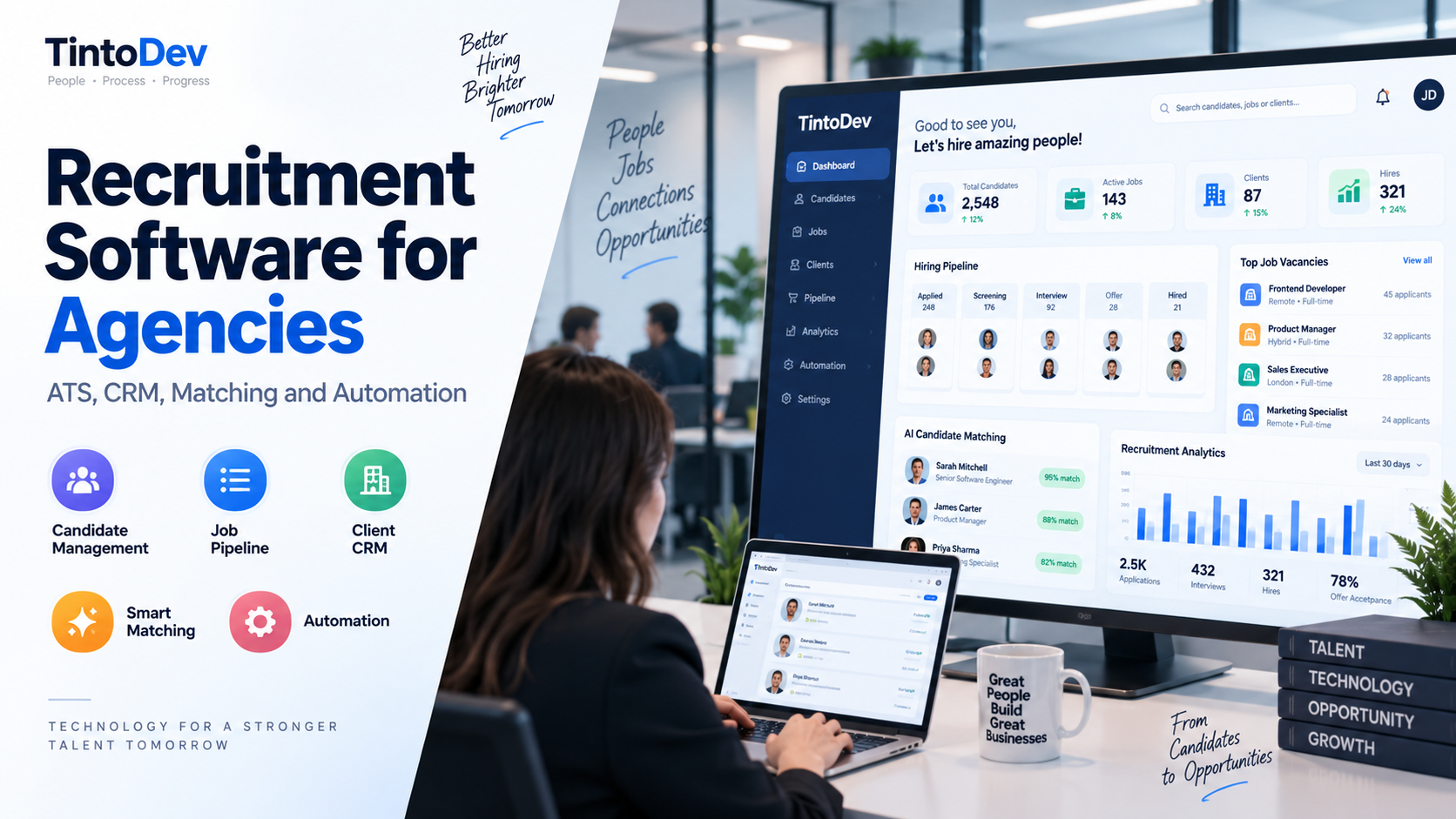
Recruitment Software for Agencies: ATS, CRM, Matching, and Automation
Recruitment software can centralize candidates, jobs, clients, forms, communications, matching, and automation in one platform.
Recruitment companies manage large amounts of information every day.
Candidates, job openings, clients, interviews, application forms, documents, emails, follow-ups, and reports are all part of an operation that can become difficult to manage when information is distributed across multiple tools.
Many recruitment agencies initially rely on:
- spreadsheets;
- email;
- online forms;
- WhatsApp;
- shared documents;
- video conferencing tools;
- independent recruitment platforms.
This approach may work when the business is small.
However, as the number of candidates, clients, and vacancies increases, manual processes can quickly become inefficient.
A recruitment software platform can centralize these processes and help agencies work faster, improve visibility, automate repetitive tasks, and scale their operations.
What Is Recruitment Software?
Recruitment software is a platform designed to manage the hiring and candidate selection process.
Depending on the needs of the agency, it may include:
- candidate management;
- job management;
- client management;
- applications;
- interviews;
- documents;
- forms;
- communications;
- candidate matching;
- reports;
- automation;
- artificial intelligence.
The goal is to reduce manual work and keep recruitment information in one centralized system.
What Is an ATS?
ATS stands for Applicant Tracking System.
An ATS is designed to manage candidates throughout the recruitment process.
It can allow recruiters to:
- register candidates;
- store resumes;
- create job openings;
- receive applications;
- move candidates through hiring stages;
- schedule interviews;
- add notes;
- filter candidates;
- track activity.
For a recruitment agency, the ATS can become the operational center of the hiring process.
Combining ATS and CRM in One Platform
Recruitment companies often need more than an ATS.
They also need to manage relationships with employer clients.
This is where a CRM becomes important.
The ATS manages candidates and hiring processes.
The CRM manages:
- companies;
- contacts;
- sales opportunities;
- proposals;
- commercial activities;
- follow-ups.
When both systems are connected, the agency can link each vacancy to a specific client and each candidate to a recruitment process.
This creates a much more complete view of the business.
Candidate Management
A strong candidate database is one of the most valuable assets of a recruitment company.
A recruitment platform can store information such as:
- name;
- email;
- phone number;
- location;
- work experience;
- skills;
- education;
- languages;
- availability;
- salary expectations;
- resume;
- documents.
This creates a searchable talent database that can be reused for future opportunities.
Instead of starting every recruitment process from zero, recruiters can search existing candidates who may already match the position.
Job Management
The platform can also centralize all open positions.
Each job can include:
- job title;
- client company;
- location;
- salary;
- work arrangement;
- requirements;
- required experience;
- skills;
- status;
- responsible recruiter;
- associated candidates.
This eliminates the need to manage vacancies across separate spreadsheets or documents.
Recruitment Pipeline
Candidates typically move through several stages during the hiring process.
For example:
- applied;
- review;
- shortlisted;
- interview;
- assessment;
- submitted to client;
- finalist;
- hired;
- rejected.
A recruitment platform can display these stages through a visual pipeline.
Recruiters can immediately understand where each candidate is in the process and what action needs to happen next.
Candidate-to-Job Matching
Candidate matching can significantly reduce the amount of time recruiters spend manually reviewing profiles.
The platform can compare candidate information against job requirements.
Matching criteria may include:
- experience;
- location;
- skills;
- languages;
- salary expectations;
- availability;
- qualifications.
Recruiters can then identify candidates with the strongest alignment for a specific vacancy.
AI-Powered Candidate Matching
Artificial intelligence can make matching even more powerful.
An AI-enabled recruitment system can analyze:
- resumes;
- job descriptions;
- professional experience;
- skills;
- keywords;
- employment history.
Based on these factors, the platform can estimate how closely a candidate matches a vacancy.
AI should not replace the recruiter's judgment.
Instead, it can help reduce the initial workload involved in searching, filtering, and reviewing large numbers of candidates.
Custom Recruitment Forms
Recruitment agencies frequently use forms to collect information from candidates.
Instead of relying entirely on external tools, recruitment software can include its own form builder.
Forms may support fields such as:
- text;
- email;
- phone number;
- single selection;
- multiple selection;
- checkboxes;
- dates;
- file uploads;
- signatures;
- open-ended questions.
These forms can be published on a careers website, embedded into job pages, or sent directly to candidates.
Form Automation
Once a candidate submits a form, the system can automatically trigger different actions.
For example, it can:
- create a candidate profile;
- update an existing profile;
- save uploaded documents;
- classify candidate information;
- notify the recruiter;
- change the candidate status;
- start an automated workflow.
This significantly reduces manual data entry.
Job Board and Careers Portal
A recruitment platform can also include a public job portal.
Candidates can use the portal to:
- search vacancies;
- filter jobs;
- create a profile;
- upload a resume;
- apply for jobs;
- update their information;
- review their applications.
For recruitment agencies, this can create a branded digital experience instead of sending candidates to multiple third-party platforms.
Advanced Candidate Search
When a database contains thousands of candidates, manual searching becomes impractical.
Recruitment software can provide advanced filters based on:
- location;
- profession;
- experience;
- skills;
- salary expectations;
- availability;
- status;
- languages;
- industry.
Recruiters can find relevant candidates much faster.
Communication Automation
Recruitment communication often involves repetitive tasks.
A platform can automate messages such as:
- application confirmations;
- interview invitations;
- interview reminders;
- status updates;
- document requests;
- rejection notifications;
- follow-up messages.
Depending on the integration, communication can be sent through:
- email;
- WhatsApp;
- SMS;
- internal notifications.
This helps recruiters maintain consistent communication without manually sending every message.
Interview Management
The recruitment system can also help coordinate interviews.
An interview record may include:
- date;
- time;
- interviewer;
- candidate;
- video meeting link;
- notes;
- result;
- next action.
The system can also integrate with external calendars to reduce scheduling conflicts.
Document Management
Recruitment processes often require candidates to submit multiple documents.
These may include:
- resumes;
- certificates;
- references;
- identification documents;
- licenses;
- immigration documents;
- employment records.
Recruitment software can keep all of these documents inside the candidate profile.
This creates a single source of information for recruiters.
Recruitment Process Automation
A recruitment workflow can be partially automated.
For example:
- candidate submits an application;
- the system creates the candidate profile;
- the resume is processed;
- the candidate is classified;
- the recruiter receives a notification;
- an interview is scheduled;
- the candidate status changes;
- the candidate is submitted to the client;
- the recruitment process is completed.
Automating these steps can significantly reduce repetitive administrative work.
CRM for Recruitment Clients
Recruitment agencies do not only manage candidates.
They also need to manage employer clients.
A recruitment CRM can include:
- companies;
- contacts;
- opportunities;
- active vacancies;
- proposals;
- notes;
- communication history;
- tasks;
- sales follow-ups.
This allows agencies to manage both sales and recruitment operations from the same system.
Recruitment Reports and KPIs
A recruitment platform can generate important business indicators.
Active Vacancies
Shows how many recruitment processes are currently open.
Candidates per Vacancy
Shows the number of candidates associated with each job.
Time to Hire
Measures how long it takes to complete a hiring process.
Candidate Sources
Shows where candidates are coming from.
This may include:
- website;
- job boards;
- referrals;
- social networks;
- internal database.
Pipeline Conversion
Shows how many candidates move from one recruitment stage to another.
Recruiter Performance
Provides visibility into the activity and workload of each recruiter.
These indicators can help managers make decisions based on real data rather than assumptions.
Recruitment Software Integrations
Modern recruitment platforms can connect with other business systems.
For example:
- HubSpot;
- form platforms;
- Microsoft 365;
- Google Workspace;
- calendars;
- payment systems;
- job boards;
- external APIs;
- artificial intelligence services.
Integrations help prevent information from being duplicated across different tools.
Standard Recruitment Software vs Custom Software
There are many commercial ATS platforms available.
For some agencies, these tools are enough.
However, recruitment companies may have unique workflows that standard platforms cannot fully support.
For example, an agency may require:
- custom forms;
- proprietary candidate matching;
- a branded job portal;
- unique business rules;
- CRM integration;
- subscriptions;
- payments;
- custom workflows;
- specialized reporting.
In these situations, custom recruitment software may provide greater flexibility.
Instead of forcing the company to adapt to a generic platform, the software can be designed around the company's actual processes.
When Does a Recruitment Company Need Custom Software?
Some common warning signs include:
- excessive use of spreadsheets;
- duplicated information;
- large candidate databases;
- repetitive manual processes;
- multiple disconnected tools;
- difficulty finding candidates;
- limited reporting;
- poor traceability;
- increasing need for automation.
When these problems begin to affect productivity or growth, a centralized recruitment platform can create significant value.
Benefits of Recruitment Software
A well-designed recruitment system can provide benefits such as:
Centralized Information
Candidates, jobs, clients, and communications are stored in one platform.
Faster Candidate Search
Recruiters can quickly search and filter talent databases.
Less Manual Work
Automation reduces repetitive administrative tasks.
Better Traceability
Every interaction and status change can be recorded.
Better Candidate Experience
Candidates receive clearer and more consistent communication.
Stronger Client Management
Recruiters can connect hiring activity with CRM information.
Better Operational Control
Managers can monitor workflows and team performance.
Scalability
The agency can manage more candidates and jobs without increasing manual work at the same rate.
Recruitment Software Development With TintoDev
At TintoDev, we develop custom recruitment platforms designed around the specific processes of recruitment agencies and staffing companies.
A solution can include:
- ATS;
- CRM;
- candidate management;
- job management;
- recruitment pipeline;
- candidate matching;
- artificial intelligence;
- custom forms;
- job portal;
- payments;
- subscriptions;
- workflow automation;
- reports;
- integrations.
The platform can be adapted to the company's existing processes instead of requiring the company to redesign its operation around generic software.
Conclusion
A recruitment agency can operate with spreadsheets, email, forms, and separate tools for a certain period of time.
However, as candidate volumes, vacancies, and clients increase, this approach becomes increasingly difficult to scale.
Recruitment software can centralize information, automate repetitive tasks, improve candidate searches, and provide better visibility across the business.
Combining an ATS, CRM, candidate matching, forms, automation, reporting, and artificial intelligence can create a much more efficient recruitment operation.
For recruitment agencies looking to scale, a centralized and customizable platform can become an important part of their digital infrastructure.
Want to apply this in your business?
Let’s talk. We can guide you with no cost or commitment.